 MEAW
삼차신경과 턱관절
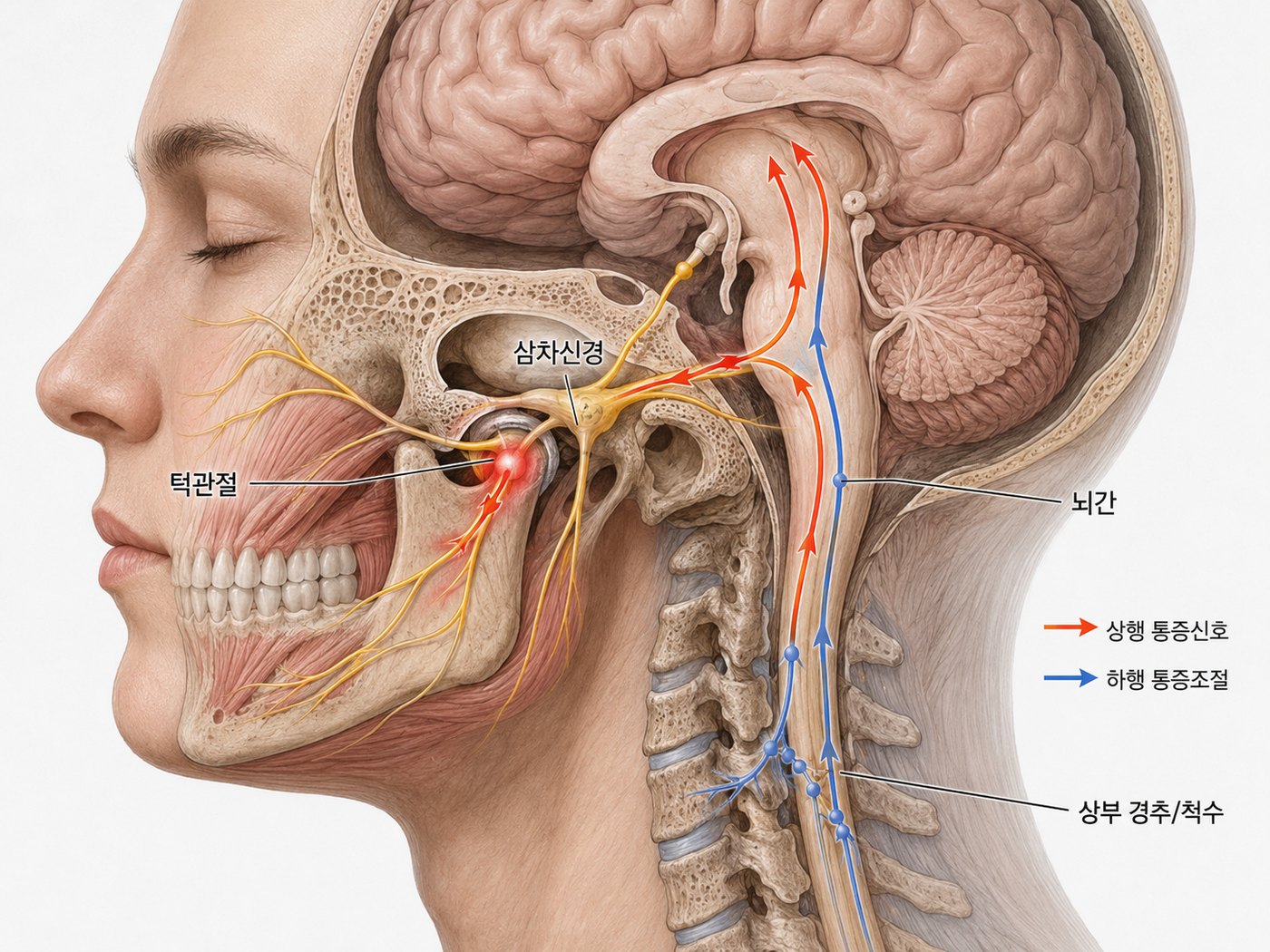
- 삼차신경 귀 앞 안쪽에서 얼굴과 턱으로 퍼지는 노란 신경
- 턱관절 붉게 표시한 자리
- 붉은 화살표 뇌로 올라가는 통증 신호
- 파란 화살표 통증을 조절하는 신호
- 뇌간 얼굴과 턱의 신호가 모이는 자리
- 상부 경추와 척수 목 위쪽의 신경이 이어지는 자리
삼차신경은 뇌신경 가운데 가장 큽니다. 얼굴 감각의 대부분과 씹는 근육의 움직임을 맡습니다.1
신경절에서 세 갈래로 나뉘어 이마, 뺨, 아래턱으로 갑니다. 턱관절의 감각은 셋째 가지에서 나온 여러 갈래가 맡습니다.2
뇌간에서 만나는 신호
얼굴과 턱의 통증 신호는 뇌간의 삼차신경핵에 모여 처리됩니다.3 목 위쪽 신경의 신호도 같은 자리로 들어옵니다.4, 5
건강한 성인의 목 뒤 신경을 마취하자, 삼차신경이 맡는 눈 깜빡임 반사가 약해졌습니다.6 두 신경이 사람에게서도 이어져 있다는 실험 결과입니다.
한 자리에서 만나는 결과
턱의 통증이 귀, 관자놀이, 목에서 느껴질 수 있습니다. 목의 긴장은 턱과 머리의 통증으로 느껴질 수 있습니다.
다른 자리에서 느껴지는 통증
눌렀을 때 퍼지는 통증
턱관절 장애 환자 230명의 턱과 목 근육을 눌렀을 때, 85%가 누른 자리와 다른 곳에서 통증을 느꼈습니다. 뺨, 귀, 이마 순으로 많았습니다.7
두통과 편두통
턱관절 장애와 편두통은 함께 있는 경우가 많습니다. 편두통이 있는 사람은 턱관절 장애를 함께 가질 가능성이 약 6배였습니다.8
귀 증상
턱관절 장애 환자 세 명 가운데 한 명에게 이명이 있었습니다. 연구 34편, 4만 7천여 명을 종합한 분석입니다.9
예민해진 통증 신경
통증이 오래된 환자 가운데 일부는 뇌와 신경의 통증 처리가 예민해져 있습니다.10 턱관절 장애 환자는 턱에서 먼 부위도 눌렀을 때 더 쉽게 아팠습니다.11
삼차신경통과의 차이
삼차신경통은 전기가 오듯 짧게 찌르는 통증이 발작처럼 반복되는 병입니다. 턱관절 장애와는 다른 병이고 진단과 치료가 다릅니다.12 이런 통증은 신경과 진료가 먼저입니다.
참고문헌
- Huff T, Weisbrod LJ, Daly DT. Neuroanatomy, cranial nerve 5 (trigeminal). In: StatPearls. Treasure Island (FL): StatPearls Publishing; 2024.
- Kucukguven A, Demiryurek MD, Vargel I. Temporomandibular joint innervation: anatomical study and clinical implications. Ann Anat. 2022;240:151882.
- Sessle BJ. Acute and chronic craniofacial pain: brainstem mechanisms of nociceptive transmission and neuroplasticity, and their clinical correlates. Crit Rev Oral Biol Med. 2000;11(1):57–91.
- Pankrath F, Pelai EB, Oliveira-Souza AIS, et al. Integration of nociceptive activity from orofacial, cranial and cervical regions in the trigeminocervical nucleus: a scoping review with clinical implications. J Oral Facial Pain Headache. 2025;39(3):1–12.
- Bartsch T, Goadsby PJ. The trigeminocervical complex and migraine: current concepts and synthesis. Curr Pain Headache Rep. 2003;7(5):371–376.
- Busch V, Jakob W, Juergens T, Schulte-Mattler W, Kaube H, May A. Functional connectivity between trigeminal and occipital nerves revealed by occipital nerve blockade and nociceptive blink reflexes. Cephalalgia. 2006;26(1):50–55.
- Wright EF. Referred craniofacial pain patterns in patients with temporomandibular disorder. J Am Dent Assoc. 2000;131(9):1307–1315.
- Dias MF, Ferro AC, Spavieri JHP, Ferrisse TM, Gonçalves DAG. Exploring the bidirectional association between migraine and temporomandibular disorders: a systematic review and meta-analysis. J Oral Rehabil. 2026;53(3):794–806.
- Alghamdi HA, Alwably AA, Alsaad FI, Alghamdi RJ, Faden A. Temporomandibular joint disorders and tinnitus: a systematic review and meta-analysis. BMC Oral Health. 2026;26(1):536.
- Harper DE, Schrepf A, Clauw DJ. Pain mechanisms and centralized pain in temporomandibular disorders. J Dent Res. 2016;95(10):1102–1108.
- La Touche R, Paris-Alemany A, Hidalgo-Pérez A, et al. Evidence for central sensitization in patients with temporomandibular disorders: a systematic review and meta-analysis of observational studies. Pain Pract. 2018;18(3):388–409.
- Bendtsen L, Zakrzewska JM, Heinskou TB, et al. Advances in diagnosis, classification, pathophysiology, and management of trigeminal neuralgia. Lancet Neurol. 2020;19(9):784–796.